
Your Own Agentic AI Stack: Open WebUI, Open Terminal & MCP Servers
By ThinkCloud
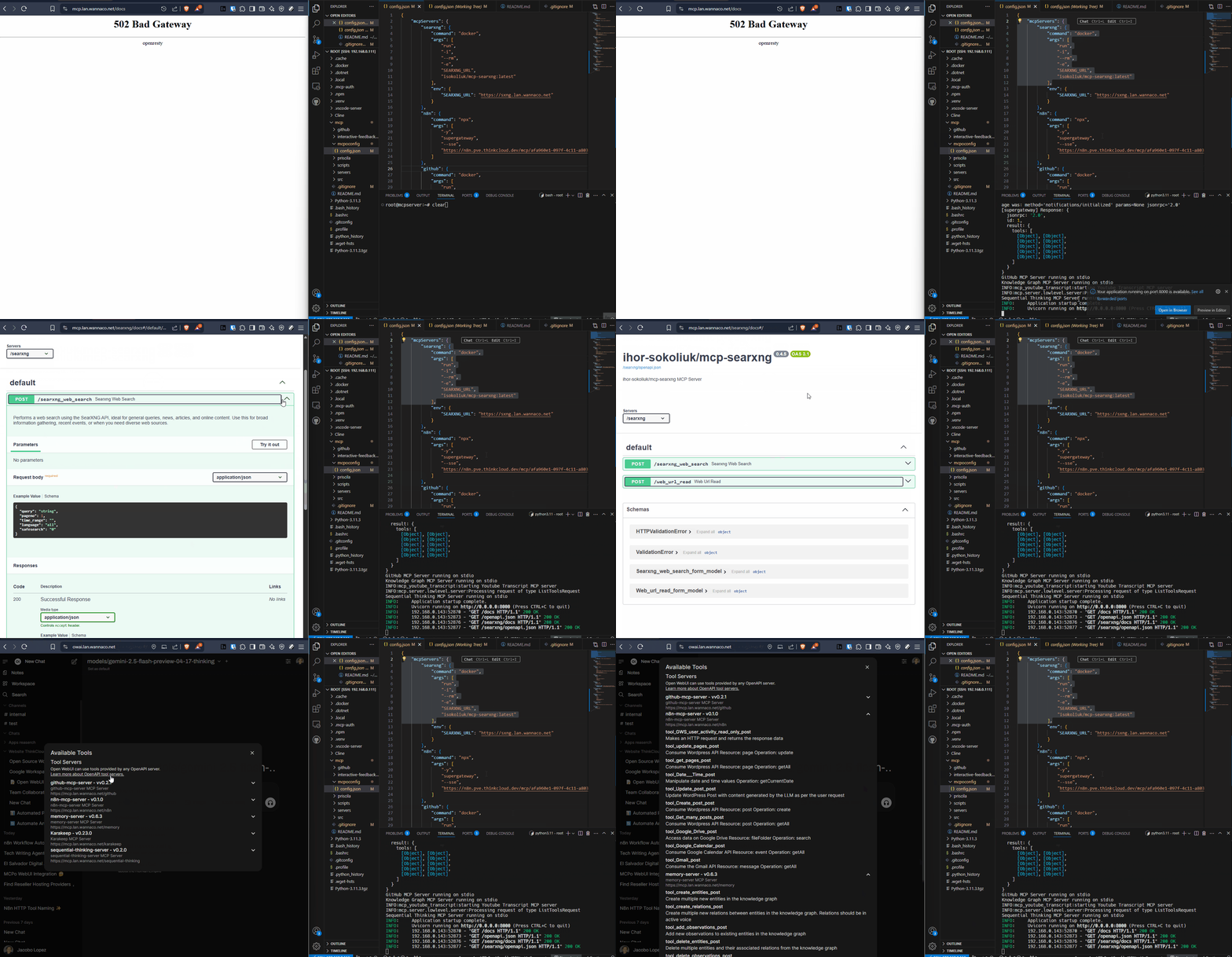
You don’t need one mega-platform. Combine Open WebUI, Open Terminal, and MCP servers into an agentic stack that works with your tools, your data, and the models you choose.
Most AI platforms sell you the whole building: the interface, the models, the integrations, the lock-in. They bundle everything into one subscription, whether you use it or not, and keep your data and your workflows inside their walls.
There’s a better way — an agentic stack built from three open, replaceable layers that you own:
- Open WebUI — the interface.
- Open Terminal — the execution environment.
- MCP servers — the connectors to your tools.
Each layer is open-source, self-hostable, and speaks standard protocols. Swap any piece without rebuilding the whole thing.
The Interface: Open WebUI
Open WebUI is a self-hosted chat and agent interface. It gives you and your team a clean, familiar place to talk to AI — but unlike the mega-platforms, it doesn’t care which model you use.
- Run open-weight models locally (Llama, Mistral, Qwen) for sensitive or offline work.
- Plug in pay-as-you-go APIs (Anthropic, OpenAI, Google) for state-of-the-art reasoning.
- Bring subscriptions you already pay for — Claude Code, Gemini Enterprise Code Assist — into the same interface.
Your team gets one chat surface. You get to decide, per task, which model handles it. That’s the control plane the big platforms don’t want you to have.
The Execution Layer: Open Terminal
Chat is fine for answers. Business runs on actions. Open Terminal is an agentic execution environment — an actual terminal your AI agents can work in.
Agents using Open Terminal can:
- Run commands, scripts, and deployments in a controlled, sandboxed environment.
- Read, write, and edit files directly.
- Execute code, inspect outputs, and iterate until the task is done.
- Operate over SSH and APIs to manage servers and services.
This is the difference between an AI that suggests a fix and an AI that applies it — with you watching every step, and with the ability to intervene at any moment.
The Connectors: MCP Servers
Models are smart, but they’re blind without tools. MCP (Model Context Protocol) is the open standard that connects AI agents to the real world — and MCP servers are the adapters.
Instead of building a one-off integration for every app, you stand up small MCP servers that expose your tools to any MCP-capable agent:
- Git and repositories — create issues, review code, manage branches.
- Search — web search, documentation, and internal knowledge.
- Memory — persistent context that survives across sessions.
- Databases and internal systems — query, update, and act on your own data.
- Media and research — video transcripts, documents, feeds.
One standard, dozens of tools. Add a new MCP server and every agent in your stack can use it immediately — no new vendor, no new subscription.
Putting It Together: An Example
Say you run a small business and you want to update your website: change a price on your services page, add a blog post, publish a new offer. Today that means finding someone technical, explaining what you want, waiting for them to be free, and paying for their time. Every time.
With this stack, you just tell your agent what you want, in plain language:
“Update the services page: change the ChatKit price to $499 and add a new blog post announcing it.”
And that’s it. Your agent handles the change end to end — updating the page, publishing the post, and putting it live on your site — with you approving each step along the way.
No ticket. No waiting. No developer needed for a one-line change. Your site stays current, and your time goes back to running the business.
No single platform sold you this. You own the pieces, the data stays in your environment, and the models — local or API — are chosen per task. (This kind of workflow is exactly why we moved off WordPress — read why a static, file-based site gives you that control.)
The right model for every task
Open-source models running locally need real hardware to match frontier APIs at serious scale — so the smart setup uses both. You decide what runs where: sensitive data stays in your environment on open-source models, and you pay for commercial models only when the task is worth it. And when you do route a request to a commercial API, that’s a deliberate choice, per task, not the default.
Build Yours With Us
This is the stack we run ourselves, and we build it for clients every day. Discovery, selection, implementation, and enablement — we’ll architect the agentic platform your business actually needs, and hand you the keys.
Ready to stop renting the building? Let’s talk about what we can build together.