
The Complete Customer Experience Stack: Chatwoot, ChatKit & Self-Serve Scheduling
By ThinkCloud
Customers don’t think in channels. They don’t say “I’ll file a support ticket” and they don’t care whether their question came through WhatsApp, your website chat, or an email. They just want an answer — fast, without repeating themselves, and without being passed around.
Too many businesses deliver the opposite. Questions sit in a web chat widget for hours. The same issue arrives three different ways and gets three different responses. And when a customer finally decides they want to talk to a real person or book a call, they hit a wall: “Call us during business hours” or a form that disappears into the void.
The fix isn’t a bigger team or a fancier chatbot. It’s a connected stack that handles each stage of the customer journey automatically — and hands off cleanly when a human is genuinely needed. We run this stack ourselves and deploy it for clients: ChatKit for instant answers, Chatwoot for the human touch, and a scheduling tool — Cal.com or Google Appointment Scheduler — for booking.
The stack, by stage of the journey
1. ChatKit: the instant first response
The first thing a customer wants is a quick answer. Is the store open? Do you offer X? How much does Y cost? Most of these are the same handful of questions, asked over and over.
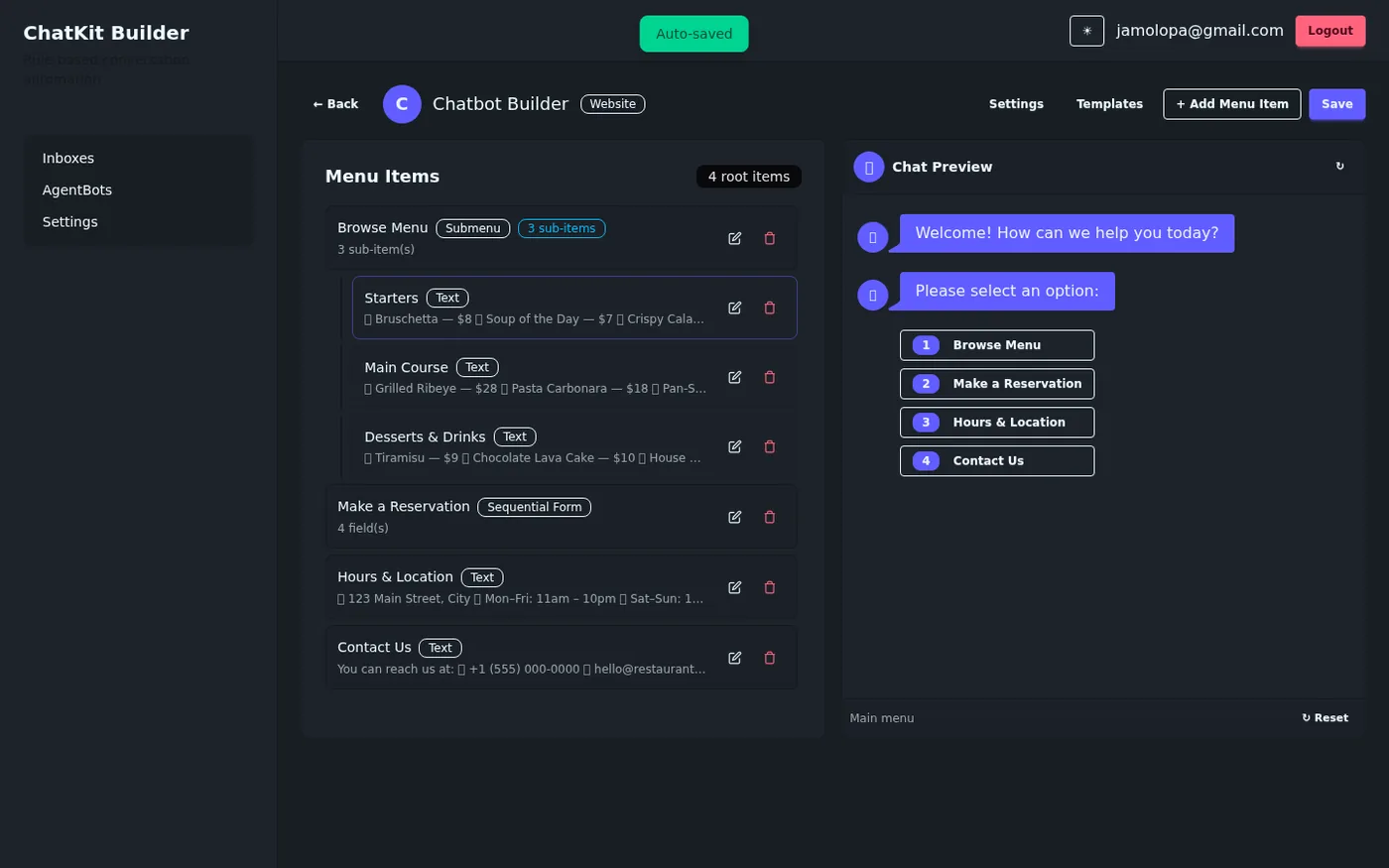
ChatKit is our visual chatbot builder for Chatwoot. It greets visitors on your website and WhatsApp with a menu — no code, no “talk to a robot” dead end. It answers the routine questions instantly, collects details through simple forms, and never keeps a customer waiting for a human to answer something a menu could handle in two taps.
The point isn’t to replace people. It’s to make sure the routine never makes a customer wait, so your team only ever spends time on what actually needs a human.
2. Chatwoot: the human touch, with context
When a customer needs more than a menu can give — a complicated question, an edge case, a conversation that needs judgment — the handoff matters more than people think.
Chatwoot is a unified inbox for every channel: website chat, WhatsApp, Instagram, email, and more. When a customer escalates from ChatKit, the conversation arrives in Chatwoot with full context — what they already asked, what they already clicked. Your support person doesn’t start from zero, and the customer doesn’t have to repeat themselves. That’s the difference between support that feels like a machine and support that feels like a team.
3. Cal.com or Google Appointment Scheduler: turning “let’s talk” into a booked meeting
Here’s where most support experiences fall apart. The customer asks to talk, and the answer is a phone number, an “email us,” or a vague “we’ll reach out.” That’s friction, and friction loses customers.
With a scheduling tool — Cal.com or Google Appointment Scheduler — every “let’s talk” becomes a booking link. Your team sets availability once; customers pick a time that works for them and it’s on the calendar instantly — no back-and-forth emails, no missed windows, no double-booking. It’s self-serve for the customer and zero coordination work for you. Prefer to keep it inside Google Workspace? Google Appointment Scheduler does the same job right from your calendar.
How it flows together
Imagine a real customer:
- They land on your site at 10pm on a Sunday with a question about pricing. The ChatKit menu answers it immediately, in seconds.
- They want to go deeper, so they choose “Talk to a specialist” — the same menu hands them the booking link for Cal.com or Google Appointment Scheduler. They pick a time that works for them, and it’s on the calendar. No waiting for business hours, no back-and-forth.
- If they’d rather ask directly, the conversation escalates to Chatwoot, where your team sees everything they’ve already asked — and can drop a booking link right into the chat when a call makes sense.
No waiting, no repetition, no dead ends. The customer got an instant answer, a self-serve booking option right in the conversation, and — when needed — a human handoff with full context. All from one continuous conversation.
Why this beats the alternatives
- 24/7 coverage without a night shift. ChatKit answers around the clock. Your team wakes up to qualified, organized conversations, not a backlog of “are you open?” messages.
- Nothing falls through the cracks. Every channel lands in one inbox, so a message can’t get lost in a personal email or an unattended widget.
- Fewer no-shows and less scheduling chaos. Cal.com or Google Appointment Scheduler removes the “we’ll email you back with times” loop entirely — the customer books when it’s convenient for them.
- Your team works on the meaningful stuff. Routine questions are handled; human time goes to conversations that actually need judgment. That’s better for your customers and your people.
- Consistent, on-brand experience. Every channel, every time, with the same voice and the same process — not a different answer depending on how the customer reached you.
Build it with us
If your customer experience has gaps — slow answers, scattered channels, scheduling chaos — this stack is the fix, and we deploy it end to end. We set up Chatwoot, build your ChatKit flows, and wire in whichever scheduling tool fits you — Cal.com or Google Appointment Scheduler — so the routine is handled automatically and the human touch lands exactly where it matters.
Ready to give your customers the experience they expect? Book a free 15-minute consultation and we’ll map your support flow together.